

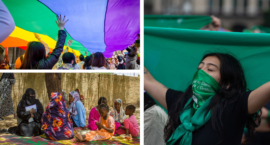
Growing Need for Contraceptives Funding in Developing Nations
The Johns Hopkins Bloomberg School of Public Health released a report in the latest issue of Population Reports, “Family Planning Logistics: Strengthening the Supply Chain,” warning that declining contraceptive funding in developing countries could result in more unwanted pregnancies and higher cases of sexually transmitted diseases. According to the report, contraceptive use in developing countries and countries of the former Soviet Union is expected to increase by 212 million users to 764 million by 2015. By then, $739 million from international donors—$585 million more than supplied in 2000—will be needed to support the rising demand. Between 1992 and 1996, 41% of contraceptives funding came through international donors, such as the US Agency for International Development (USAID) and the United Nations Population Fund (UNFPA).
According to the report, the UN estimates 360,000 additional unintended pregnancies, 150,000 more induced abortions, 11,000 more infant deaths, and 800 more maternal deaths for every $1 million decline in contraceptive funding.
The Bush Administration placed a hold on the release of $34 million in UNFPA funding, originally appropriated in January 2002. The loss of UNFPA funds has already caused the agency to make cut backs in programs and personnel, as US funding accounts for 13 percent of the UNFPA budget.
6/19/2013 House Passes 20 Week Abortion Ban - Yesterday, the House of Representatives approved a nationwide abortion ban after 20 weeks gestation in a vote of 228 to 196. . . .
6/18/2013 Supreme Court Strikes Down Proof of Citizenship Voter Requirements - On Monday, the United States Supreme Court struck down an Arizona law requiring voters to provide proof of citizenship before being allowed register to vote.
In an opinion written [PDF] by Justice Antonin Scalia, the Court ruled that the Arizona statute violated the National Voter Registration Act (NVRA, also known as the "Motor Voter Law") of 1993, which created a federal form that individuals can mail in to register to vote in federal elections. . . .