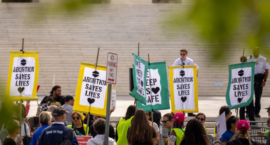


US District Court Judge Catherine Eagles issued a preliminary injunction yesterday against a provision in a North Carolina abortion law that would require abortion providers to perform an ultrasound at least four hours prior to an abortion. The law, scheduled to take effect today, would also require that providers describe the images in the ultrasound to the woman and offer patients the opportunity to hear the fetal heartbeat. Judge Eagles indicated that the plaintiffs in the case would likely prove these portions of the law unconstitutional. Judge Eagles did not however block a provision of the law that imposes a 24 hour waiting period on women seeking abortions.
Melissa Reed, vice president for public policy at Planned Parenthood Health Systems, stated, "Today the court stood on the side of women and health care providers who are faced with personal, private and very complicated medical decisions every day."
In July, the North Carolina General Assembly voted to override Governor Beverly Perdue's (D-NC) veto of an abortion bill. It is estimated that the new requirements would lead to around 2,900 additional births annually and would cost taxpayers $6.7 million in the first year and $35 million over five years.
Media Resources: Washington Post 10/26/11; Reuters 10/25/11; Feminist Daily Newswire 7/28/11
5/20/2013 Afghan Violence Against Women Law Blocked in Parliament - On Saturday, the Speaker of the Lower House of Afghan Parliament delayed a vote on the Elimination of Violence against Women law after two hours of vociferous debate between conservative religious and more liberal members of Parliament. . . .
5/20/2013 Walmart, American Retailers Refuse to Join Bangladesh Accord - Walmart, along with 13 other major North American companies, refused to sign a legally binding agreement to improve working conditions for overseas factory workers that manufacture their clothes after a garment factory collapsed in Bangladesh killing an estimated 1300 workers, the New York Times reports.
The agreement requires retailers pay $500,000 to improve worker safety measures over a five year period. . . .