For Many Incarcerated Women, the State Is Their Abuser

Let me tell you what it’s like to live in state-sanctioned, gender-based violence. 

In prison, we wake up when male guards tell us to. We wear what they tell us to wear. We eat what they give us, when they decide to give it. We go where they permit, speak when they allow, and exist under their constant surveillance. Our bodies belong to the state. Our movements are controlled. Our communications are monitored. They have the power to deny or delay our medical care, and our complaints go ignored or punished.

Incarcerated journalist Kwaneta Harris explains that when we tolerate sexual assault in women’s prisons, we signal that the state can commit violence against people without consequences.

What Iran’s Crackdown Looks Like From Inside: A Q&A With Nasrin Sotoudeh and Reza Khandan

As mass protests and a deadly crackdown grip Iran, human rights lawyer Nasrin Sotoudeh speaks from Tehran while her husband, activist Reza Khandan, calls in from Evin Prison—offering a rare, firsthand account of repression, resistance and the stakes for democracy inside the country.

“My message has always been to use all non-violent means to persuade governments to uphold democracy and human rights. Small actions can have big impacts.”

“… You can’t bomb a country into democracy.”

Olympians on Olympians: Women Athletes Honor the Trailblazers Who Made Today’s Games Possible

Organizers of the 2026 Milano-Cortina Winter Olympics are touting “the most gender-balanced Olympic Winter Games in history,” reflecting years of pressure from athletes who have questioned why women and men do not always have the same number of events or chances to participate.

These gains did not happen on their own—they are the result of sustained advocacy by women athletes who have pushed the International Olympic Committee to expand women’s participation, add events, and commit to gender equity in both athlete quotas and medal opportunities. Even as parity edges closer, competitors and supporters continue to call out the remaining gaps—keeping the pressure on Olympic leadership to deliver full equality across all sports.

A Letter to My Future Self in a Time of Undoing

This essay is one of three “Letters to My Future Self” included in Flipping the Menopause Script Is Essential to Democracy. Through personal reflection, political memory and spiritual inquiry, these letters consider menopause and midlife as thresholds—moments of undoing, reckoning and renewal. They invite readers to see aging not as decline, but as a site of transformation, agency and hard-won power.

“Since we were born in 1967 … we were told, implicitly and explicitly, that we were the first generation of Black children born into the fullness of freedom promised by law. The first generation of Black women was meant to be fully protected by the government. Free to vote without obstruction. Free to be educated without limits. Free to open a bank account, hold a credit card and own property. Free to marry who we loved. Free to live without our rights being constantly renegotiated.

“That was the promise we inherited. …

“Menopause sharpened my understanding that rights, like bodies, require attending to and care. That neglect is a political choice. That erosion is not accidental. That what happens to aging bodies mirrors what happens to democracies that refuse to honor those most impacted by time, labor and sacrifice. So I am writing to you, Future Me, because I want us to meet each other awake.

“Who are we when I finally arrive?

“Are we softer without being smaller? Stronger without armor? Have we learned how to rest without apology? Have we let go of the belief that our worth must be proven through exhaustion? …

“If you are an ancestor now, please remind me of what mattered most. Not the accolades. Not the fear. Not the scarcity. Remind me that I belonged to myself. That I belonged to my people. That I trusted the wisdom of my changing body.”

(This essay is part of the latest Women & Democracy installment, published in the middle of Black History Month, in partnership with Black Girls’ Guide to Surviving Menopause. Menopause is not only a physical transition—it is also cultural, social and political. Recognizing its full scope is essential to advancing true health and civic equity.)

A Letter to My Future Self: Menopause, Joy and Black Queer Becoming

Elan Pratt writes toward her future self, exploring Black queer joy, intergenerational healing and the power of story to carry us forward.

“When I attended Iranti Ẹ̀jẹ̀, the writer and activist Rachel Cargle led a guided meditation enabling participants to interact with their future self.

“I closed my eyes and created a portal to my 48 year-old self’s house. She was making soup in her kitchen, her hair was long and loc’d, her chest was flat. …

“we were prompted to relay a statement to ourselves. I told myself, ‘The laughter is my favorite,’ to which my future self replied, ‘The laughter remains.’ And with all the madness in the world, it’s incredibly comforting that the laughter will remain. That joy will still be found through struggle, as it always has. As Black folks, it’s how we have always pushed through—not just to survive, but to thrive.”

(This essay is part of the latest Women & Democracy installment, published in the middle of Black History Month, in partnership with Black Girls’ Guide to Surviving Menopause. Menopause is not only a physical transition—it is also cultural, social and political. Recognizing its full scope is essential to advancing true health and civic equity.)

The Incomplete Story of Menopause: Where Medical Racism, Patriarchy and White Empiricism Intersect

Like many of the women in my family, I had early menopause and had completed the process by the age of 50, the same as my mother.

The alarming truth is that we know more about reproductive organs in other species than we do our own. Our limited societal understanding of the lifespan of ovarian function is a casualty of the intersection of medical racism, patriarchy and white empiricism. 

The story will remain incomplete until we have our research and clinical care guided by the menopausal experiences of those who experience it.

(This essay is part of the latest Women & Democracy installment, published in the middle of Black History Month, in partnership with Black Girls’ Guide to Surviving Menopause. Menopause is not only a physical transition—it is also cultural, social and political. Recognizing its full scope is essential to advancing true health and civic equity.)

Letters to My Future Self: Choosing Yourself Is the Turning Point

One of three “Letters to My Future Self” featured in Flipping the Menopause Script Is Essential to Democracy. Blending poetry, spiritual reflection and lived experience, these letters explore menopause and midlife as sites of transformation, rest and reclamation.

“Let the cleavage of your wound smile out at the world from your unbuttoned dress. You know how to do it. This is an exercise in nerve. You need nerve to be free. (And you need freedom to fulfill your earthly mission.) …

“The liminality you are in is a temporary chrysalis. Your whole being is restructuring, and you’re shedding the parts of you that are no longer useful. When you emerge, you’ll soar.”

(This essay is part of the latest Women & Democracy installment, published in the middle of Black History Month, in partnership with Black Girls’ Guide to Surviving Menopause. Menopause is not only a physical transition—it is also cultural, social and political. Recognizing its full scope is essential to advancing true health and civic equity.)

Midwifery Is for Menopause, Too

When I was younger, I remembered the kitchen turning into a collective of family midwives. Without understanding, they boisterously discussed the “change of life,” “personal summers” and somebody being “carefree, hot in the pants.” They waved their hands in praise, testifying, “Tell it!” “Who you tellin’!” “Just you wait!” 

Their language seemed mysterious to me since I was less than six months into menarche. The only reason I was allowed in that sacred space was because I started my period. I was seen and not heard. But I was an audience in this menopause reverie.

Midwives, for centuries, chose who they passed on the secrets of the womb. These secrets included how to support those beyond their childbearing years and whose bleeding cycle unexpectedly came to an end. My family’s knowledge was passed down during the communing of the midwives and womb bearers. 

Midwifery is individualized care. It’s my #1 favorite aspect of the profession. Midwifery includes the menopausal experience. In my one-hour appointments, each person is able to talk freely. I listen, gather precious information, hear their concerns, hopes and expectations, so that I can offer care that’s specifically designed for their journey. To improve their reproductive and menopausal health, we discuss their experience and the differences between perimenopause, menopause and post menopause stages. I want them to feel affirmed and know where they are on their journey. Fourteen years later, and over 50 perimenopausal, menopausal and post-menopause clients later, the individualized care model remains.

(This essay is part of the latest Women & Democracy installment, published in the middle of Black History Month, in partnership with Black Girls’ Guide to Surviving Menopause. Menopause is not only a physical transition—it is also cultural, social and political. Recognizing its full scope is essential to advancing true health and civic equity.)

Menopause in Prison Is a Public Health Crisis We’re Ignoring

Speaking from a Texas prison, journalist Kwaneta Harris reveals how menopause is neglected and punished for those living under state control.

“You know what menopause looks like for most folks? Maybe some hot flashes at work, some joint pain and mood swings. Perhaps you adjust your thermostat frequently or get hormone therapy from your doctor.

“Now let me tell you what menopause looks like under state control. Imagine having a hot flash in a non air-conditioned cell with a recorded temperature of 119 degrees. The guards won’t let you have ice water. You’re bleeding through your state-issued white uniform because you had to beg an 18-year-old man-child for a pad this morning, and he said, ‘Maybe later.’ You get exactly five tampons a month, along with a handful of pads, if you’re lucky. Your hormones are all over the place, but there’s no hormone replacement therapy. Just Tylenol—if the guards remember.

“And here’s the kicker: They write you up for having an ‘attitude problem’ when you’re actually having hormone-induced mood swings from perimenopause. Those write-ups? They keep you from getting parole. So now you’re not just dealing with your biology changing, you’re trapped here longer because your biology is being criminalized.”

(This essay is part of the latest Women & Democracy installment, published in the middle of Black History Month, in partnership with Black Girls’ Guide to Surviving Menopause. Menopause is not only a physical transition—it is also cultural, social and political. Recognizing its full scope is essential to advancing true health and civic equity.)
Queering Menopause: A Conversation on Story, Power and Policy

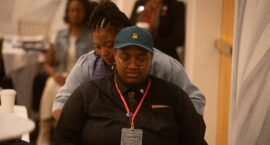
What would it mean to treat menopause not as a private medical event, but as a collective, political and even spiritual transition—one that spans far more bodies and experiences than mainstream narratives allow?

In this wide-ranging conversation, writers and cultural workers Syd Yang and Austen Smith reflect on their own experiences of perimenopause and menopause—experiences shaped by queerness, trans identity, spirituality and community—as well as the broader systems that render many menopausal people invisible.